Wednesday, January 31, 2007

Deliver kegs, then fill some more

It's a real Root Beer Fest for the rest of the week. This morning, I took ten of the kegs that I filled yesterday to our wholesaler in Council Bluffs. They, along with our Norfolk wholesaler, were bought out by an Omaha company recently. With luck, I'll get to drive to Omaha instead of Council Bluffs from now on; our straight truck isn't licensed in Iowa, so I've been having to take the van.


Loaded up and ready to go


Lovely day for a drive


I got back to Columbus around 2:30 and started filling kegs for the Norfolk delivery: 20 half-barrels and 40 five-gallon kegs. I got the half-barrels filled along with 14 of the smaller cans, draining one seven-barrel tank and part of another one in the process. I dropped another seven barrels of root beer from upstairs into the empty tank; it should be carbonated by tomorrow, so I can fill the other 26 five-gallon kegs. With luck, I'll be able to make the delivery tomorrow, but more likely it'll be Friday.

Tuesday, January 30, 2007

Tri-Clamp Gaskets, and Big Root Beer Orders

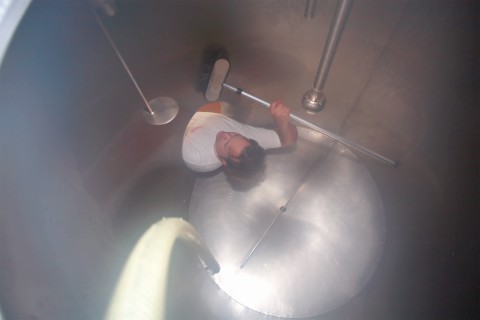
More necessary tedium today: replace all the tri-clamp gaskets in the brewhouse. (The ones on the fermenters and bright tanks will get their turn later.)


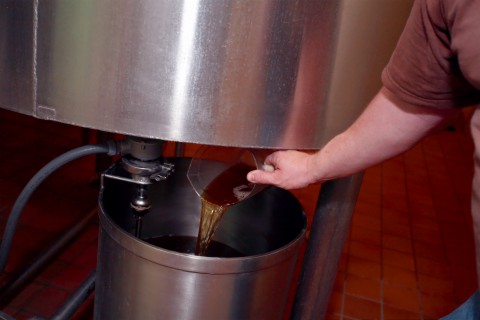
One ring, two ring, old ring, new ring


There are 137 tri-clamp fittings in this picture. Can you find them all?


Two tri-clamp joints and a valve


That took most of the day, and I was looking forward to a relaxing beer before going home. But a phone call from our wholesaler in Council Bluffs asking for sixteen half-barrels of root beer was shortly followed by an order from our wholesaler in Norfolk asking for 40 five-gallon kegs and 20 half-barrels of root beer, all of which needs to be delivered by Friday. I don't have that much root beer in the cellar, but I do have fourteen barrels ready to go, and another 28 standing by, uncarbonated, upstairs.


So here's the plan: fill as many half-barrels as possible from one of the tanks in the cellar, then transfer seven barrels into that tank from upstairs and carbonate it tonight. Then I should be able to fill the rest of the kegs tomorrow.


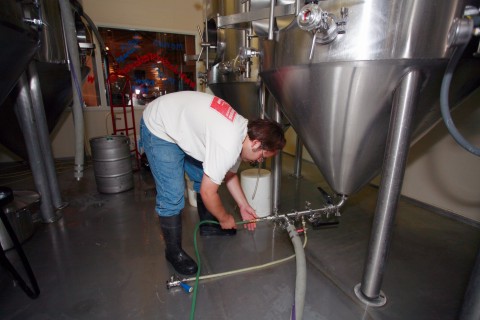
Filling a keg: The (root) beer comes out of the tank and into the keg "backwards" through the keg coupler


The keg is full when (root) beer comes spewing out the other side of the keg coupler


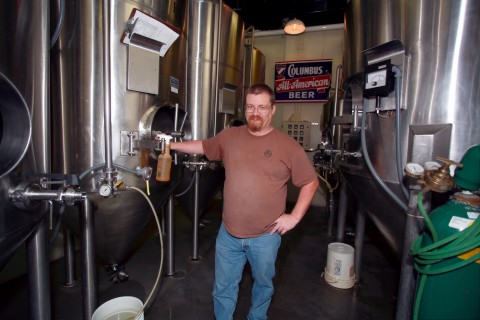
I got twelve half-barrels plus one quarter-barrel out of the root beer tank. I can take ten to Council Bluffs tomorrow, then come back and fill up the ones for Norfolk for delivery on Thursday. And I did have time for that relaxing beer that I thought I was going to get earlier.


I'll have to rewrite my schedule for the next few days when I get home.

Monday, January 29, 2007

Keg Couplers

[Edit 2006-01-30: Added a couple of pictures.]


Normally, this would be Line Cleaning Day, but I'm going to be doing some maintenance on the draft lines this week. To that end, I made a quick trip to Ace Hardware to order 300 feet of tubing that I'll use to replace the old CO2 and beer jumpers from the kegs to the wall brackets. That will happen on Friday, so I'll clean the lines at the same time.


I unloaded the kegs from Saturday's festival and carried them into the basement, where I would spend most of my day. Judah from Nebraskaland Distributing in Grand Island made his regular Monday morning keg pickup around 10:00. (Five 1/6-barrels of Root Beer and a half-barrel of Tin Lizzie Hefeweizen.)


Today's big project is to disassemble, clean, and rebuild the twelve keg couplers in the cellar. Tedious, sticky work, but it's probably the first time they've been properly cleaned in ten years, plus most of the O-rings needed replacing. I didn't expect the job to take four and a half hours. I'm going to add "keg coupler cleaning" to my regular line cleaning routine from now on.


A keg coupler, as if you didn't know


A very dirty coupler probe


All the parts


The batch of All-American Gold that I brewed on Friday took off like a volcano, and blew foam and yeast all over the fermenter room floor, so that all got hosed down after lunch. The gravity has dropped from 11.0°P to 3.5°P — corresponding to about 4.1% abv — and it's still going strong. I may end up diluting it a wee bit when I filter it. Or maybe not.


Tomorrow, I'll start replacing the 300+ tri-clamp gaskets. That should keep me busy for a couple of days, at least.

Sunday, January 28, 2007

6th Annual Winterfest Ales & Auction

We're taking beer to the 6th Annual Winterfest Ales & Auction in Lincoln tonight. It's a fundraising event for Matt Talbot Kitchen & Outreach, hosted by the Advertising Federation of Lincoln. I'm told they're expecting 700 people tonight, 100 more than last year.


We loaded up the kegs at 3:00 and started the 1½-hour drive to Lincoln.


Paris & I kept pretty busy pouring three-ounce samples of All-American Gold, Princess of Darkness Porter, Fire in the Hole! Rauchbier, and Bugeater Brown Ale, but I did get to take a quick break to take pictures of all the brewery booths.


Boz from Aksarben Brewing pours some Gold


Suzette from Finocchario Wine Company watches Bob try to remain upright


Empyrean's Rich Chapin pulls me a taste of his Cask-Conditioned Imperial ESB


Levi William and his band rock the house


Paris and me in the Gottberg booth


Travis says "Hopluia!" at the Spilker booth.


Sam Spilker evaluates Thunderhead's IPA, while Trevor Schaben looks inordinately pleased with himself


Maggie and Jenny have fun pouring Boulevard beers


Upstream's Zac Triemert provided some of his excellent bottle-aged beers


A good time was had by all, and then at 9:30 it was over. From the weight of the kegs, it looks like the Princess of Darkness Porter and the Fire In The Hole! Rauchbier were our most popular beers, or at least we poured more of them than the other two. (Lots of people tried the Rauchbier, but about half of them poured it out. You either like smoked beers or you don't.) We loaded everything back into the car and got home around 11:30. I'll take the kegs back to the brewery on Monday.


I need to figure out a better way to pour small quantities of beer from small kegs. The picnic pumps are handy, but they tend to leak a lot, and they're so low to the floor that pumping them all night was back-breaking work. I have a cooler with a cold plate and four taps, but it's a real pain to haul around and set up. Upstream had some nifty standalone taps that use tiny CO2 bulbs; I think I'll look into getting a few of them.

Friday, January 26, 2007

All-American Gold

Today's project: brew seven barrels (217 gallons) of our second-best-selling beer, All-American Gold. It's a pretty light beer, with only 350 pounds of malt. The target Original Extract is 9.1° Plato (specific gravity 1.036), with an estimated bitterness of 12 IBU and color of about 1.4° Lovibond.


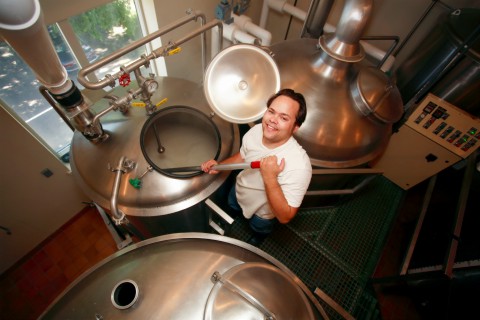
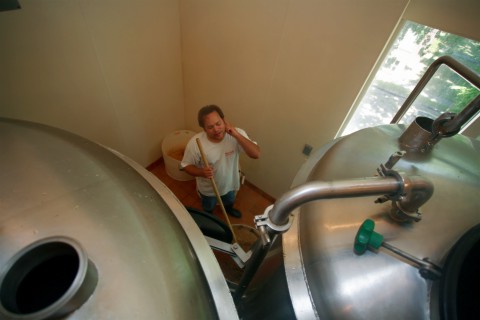
(Note about the pictures here: they were taken during a brew last June by my wife's brother-in-law, Bill Blake. The smiling young man you see in many of the pictures is my former assistant/intern/rented mule Jeremy Kirby, who is now studying at the Versuchs- und Lehranstalt für Brauerei in Berlin. Jeremy works harder than I do, he cleans stuff better than I do, and he's going to make one hell of a good brewer.)


I put the malt in the grist case yesterday, and the water's hot, so I started mashing in right away at 9:21. It took about ten minutes to get the grist and the water into the mash tun, and thanks to the well-modified Briess malt that I use, I was able to start the vorlauf at 9:36. The runoff was cloudier than I like, but it tasted great, and the first runnings measured 18.6°P. Sparging ended around 11:00, and the kettle was full by 11:37. Last runnings measured 2.0°P, and the kettle extract was 11.0°P, quite a bit higher than my target of 8.4°P. Nice efficiency there.


Jeremy mashes in


Running off


The wort started boiling at 12:15. In go the hops, about two pounds of Saazer. During the boil, I have time to hook up the fermenter hoses and pull the spent grain out of the mash tun.


In go the hops


Jeremy hooks up the fermenter...


...while I supervise.


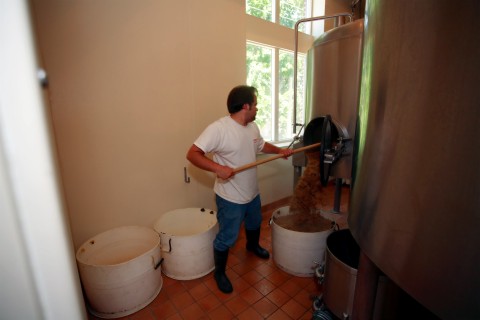
Jeremy pulls out the spent grain


Jeremy sweats while pulling out the spent grain


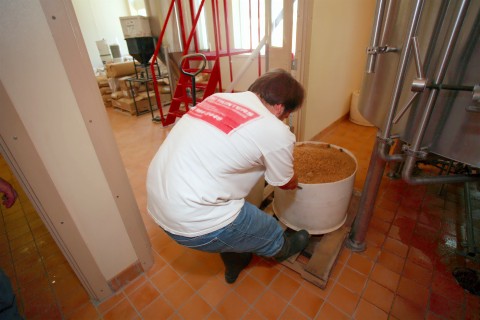
Loading the pallet


Taking out the trash


Making it shine


The Whirlfloc B®, an Irish-moss-like kettle coagulant, went into the kettle at 13:05, and the boil ended ten minutes later. The Original Extract is 11.2°P, much higher than my target, but that means I only got 1.8% evaporation. (Eight to ten percent per hour is what you should expect, but this system refuses to go that high.) The whirlpool pump runs for three minutes, then the wort settles for twenty. Usually I can nip downstairs to the pub to get a beer and a bite to eat, but today I have to use the time to finish cleaning the mash tun, since I've been busy typing these notes.


It's 15:00; the brewhouse vessels are clean, the heat exchanger is cleaned, rinsed, and sanitized, and the only thing left to do up here is mop the floor.


More goodies on my desk! Boxes and boxes of Tri-Clamp gaskets. I'm going to replace all 299 of them on all three floors in an effort to clean things up around here.


I got an order for a keg of All-American Gold, and he wants to pick it up tomorrow. Normally, that's Very Short Notice, but since I have to fill some kegs for tomorrow's beer festival in Lincoln, I told him I can fill his too. But I think I'll take a beer break first.


OK, that's better. It's amazing what a pint of Hefeweizen and a cup of clam chowder can do. It's ten minutes to four, and I have to fill a half-barrel of Gold, plus a sixth-barrel each of Gold, Princess of Darkness Porter, Fire in the Hole! Rauchbier, and Bugeater Brown Ale. I don't have my camera today, so I'll post pictures of the keg-filling process when I fill the regular weekly orders next Thursday or Friday.


16:15. The kegs are filled, the boots are off, and I've got about five minutes' worth of recordkeeping to do. Then I'll have one more beer and walk home.


So there you go; a rare day in the life of a brewer where everything went pretty much according to plan. Next time I brew, I won't go into nearly so much detail. Ditto for every new job (filtering, kegging, etc): I'll include all the gory details only the first time I write about it.


And now it's time for a beer at home. Tomorrow afternoon, I'll come back, load up the car, and drive down to the festival in Lincoln.

Thursday, January 25, 2007

Root Beer, Orange Cream Soda, Grain In, Parts

We go through a lot of root beer here at Gottberg. Not only do we sell pints and growlers galore over the bar, but several wholesalers in Nebraska and one in Iowa take kegs out of here by the pallet. So today's big task was to make 28 barrels (868 gallons) of root beer. We also sell a Red Cream Soda that's not nearly as popular as the root beer, but it does have a loyal following. We alternate batches of Red and Orange Cream Soda, and since the Red tank was nearly empty, I kegged it off and made 7 barrels (217 gallons) of the Orange.


Soda is really easy to make. (Actually, it's pretty boring compared to brewing beer, but it pays the bills.) So much hot water, so much flavor extract, a dash of citric acid for bite and a dash of sodium benzoate to help keep it fresh. And then there's the sugar. The sugar comes in 100-pound sacks that I carry up the six-stair platform to the kettle and dump them in. Two hundred and fifty pounds of sugar per seven barrels. That's 2.3 ounces of sugar per pint. That's 260 calories per glass, nearly twice what's in the beer. But like I said, it pays the bills.


Once it's all mixed up and the sugar has dissolved, I run the soda through the heat exchanger to the dedicated soda tanks in the cellar and force-carbonate it. After a day or two, it's fizzy enough to keg or to serve right out of the tank. Seven barrels of root beer lasts us about a week; the same amount of cream soda lasts a couple of months.


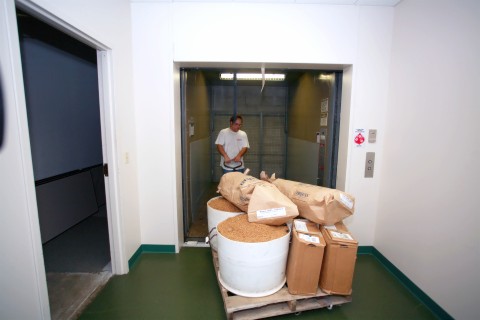
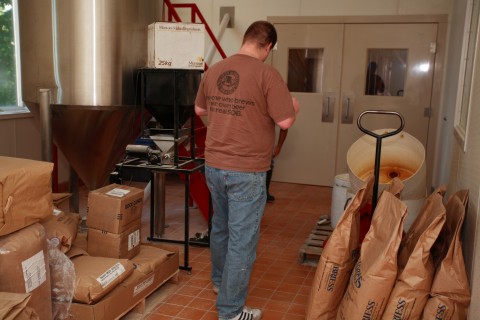
A shipment of yeast arrived today, so tomorrow I'm planning to brew seven barrels of our All-American Gold, our second-best-selling beer. Since I've got time to kill while the heat exchanger cleaning cycle runs, I can get the grain ready for the brew. Three hundred fifty pounds (seven 50-pound sacks) of malt get carried up the five-stair platform and dumped into the grist case. There it sits until tomorrow morning. I also got tomorrow's fermenter and hoses cleaned and sanitized to save a bit of time.


Getting the grain ready. Photo by Bill Blake.


Also newly-arrived on my desk are a boxful of parts to rebuild all of my keg couplers, which are in desperate need of cleaning and maintenance, and a seal kit for my beer filter, which has been leaking beer and DE and generally making a mess. Those two projects will happen early next week.


Had a couple of beers at the bar, then it was time to go home.

Canned beer turns 72 today

From Days That End in Y:


Canned beer makes its debut on this day in 1935. In partnership with the American Can Company, the Gottfried Krueger Brewing Company delivered 2,000 cans of Krueger's Finest Beer and Krueger's Cream Ale to faithful Krueger drinkers in Richmond, Virginia. Ninety-one percent of the drinkers approved of the canned beer, driving Krueger to give the green light to further production.


Read the entire article here. View The History Channel's video on the subject here.